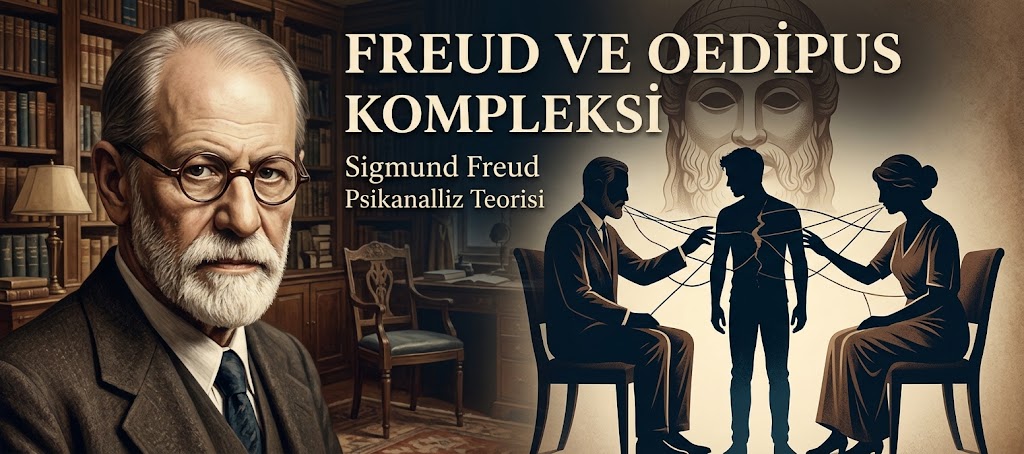
What Is the Oedipus Complex? Freud’s Theory and Its Place in Psychology
The Oedipus complex is one of the best-known concepts introduced by Sigmund Freud, the founder of psychoanalysis. It was developed as a way of understanding a child’s early emotional development and the complex feelings of attachment, love, rivalry, jealousy, and identification that may emerge within relationships with parents.
Freud did not view the Oedipus complex simply as a conscious desire directed toward a parent. Instead, he understood it as a largely unconscious psychological process. According to classical psychoanalytic theory, this process may play a role in personality development, the formation of boundaries, identification with parents, and later relationship patterns.
What Does the Oedipus Complex Mean?
The term Oedipus complex takes its name from Oedipus, a figure from Greek mythology. Freud developed the concept partly through his interpretation of Sophocles’ tragedy Oedipus Rex.
In classical Freudian theory, the Oedipus complex is particularly associated with the phallic stage of psychosexual development, approximately between the ages of three and six. During this period, children become increasingly aware of relationships between family members and begin to understand their own position within the family.
A child may experience a strong emotional attachment to one parent while occasionally perceiving the other parent as a rival for attention and affection. However, this should not be interpreted in the same way as adult romantic or sexual relationships. From a psychoanalytic perspective, the process involves developmental themes such as love, possessiveness, jealousy, rivalry, fear of loss, and identification.
How Does the Oedipus Complex Develop According to Freud?
Freud divided psychosexual development into several stages: oral, anal, phallic, latency, and genital. The Oedipus complex is primarily associated with the phallic stage.
During this period, children become increasingly aware of the relationship between their parents. They may feel particularly attached to one parent and may not always want to share that parent’s attention. This can sometimes lead to feelings of jealousy or rivalry toward the other parent.
In classical Freudian theory, identification plays an important role in resolving this conflict. Over time, the child identifies with the parent who may previously have been experienced as a rival. Through this process, the child gradually develops a greater understanding of family roles, relationships, and interpersonal boundaries.
Freud also proposed that the resolution of the Oedipal conflict contributes to the development of the superego, the part of personality associated with internalized rules, values, and moral standards.
What Are the Signs of the Oedipus Complex?
The Oedipus complex is not considered a mental health disorder or psychiatric diagnosis. Therefore, it is not appropriate to describe it through a specific clinical list of “symptoms.”
Within classical psychoanalytic theory, behaviours such as a young child becoming strongly attached to one parent, showing jealousy toward the other parent, wanting a parent’s attention exclusively, or displaying competitive behaviour within the family may sometimes be interpreted in relation to Oedipal dynamics.
However, the presence of such behaviours does not necessarily indicate a psychological problem. Wanting parental attention, experiencing occasional jealousy, and forming particularly strong attachments to a parent can also be normal aspects of childhood development.
How Can the Oedipus Complex Appear in Adulthood?
According to psychoanalytic theory, early childhood experiences do not simply disappear. Instead, aspects of these experiences may continue to influence a person’s unconscious emotional world and relationship patterns.
For this reason, unresolved Oedipal themes may sometimes be explored in relation to adult romantic relationships, attitudes toward authority, jealousy, competition, intimacy, separation, and fear of loss.
For example, repeatedly becoming involved with emotionally unavailable people, experiencing intense rivalry, finding oneself in relationships involving complicated triangular dynamics, or experiencing love alongside strong feelings of guilt may be explored within a broader psychoanalytic framework.
However, it is important not to explain every relationship difficulty through the Oedipus complex. Psychological and relational difficulties are usually influenced by many factors, including attachment experiences, childhood relationships, trauma, personality, current circumstances, and interpersonal experiences.
The Oedipus Complex and Parent–Child Relationships
At the centre of the Oedipus complex is not simply the child’s relationship with one parent, but a triangular relationship involving the child and both parents.
From a psychoanalytic perspective, children gradually discover that their parent does not belong exclusively to them and that their parents have relationships and emotional lives that exist independently of the child.
This realization can be psychologically significant because it introduces the child to boundaries, separation, frustration, and the recognition that not every wish can be fulfilled.
For this reason, some contemporary psychoanalytic perspectives interpret Oedipal development more broadly. Rather than focusing exclusively on sexuality, they may emphasize themes such as accepting the presence of a third person, separation, boundaries, rivalry, loss, and recognizing that other people have relationships that exist independently of oneself.
What Is the Difference Between the Oedipus Complex and the Electra Complex?
While the Oedipus complex is primarily associated with Freud, the term Electra complex is more closely associated with Carl Gustav Jung. It has traditionally been used to describe a girl’s emotional attachment to her father and rivalry with her mother.
Freud, however, continued to explain female psychosexual development within his own theoretical framework and did not adopt the Electra complex as a central concept in his theory.
Today, both concepts are generally understood within their historical and theoretical contexts rather than as established clinical diagnoses.
Is the Oedipus Complex Still Accepted Today?
The Oedipus complex is not considered a scientifically established mental disorder or diagnosis. It does not appear as a psychiatric disorder in contemporary diagnostic systems such as the DSM-5-TR or ICD-11.
Several aspects of Freud’s original theory remain controversial and have not been established as universal developmental processes by modern empirical psychology. Nevertheless, the Oedipus complex continues to have historical and theoretical significance within psychoanalysis and some contemporary psychodynamic approaches.
Questions about how early relationships with parents influence later intimate relationships, how people experience jealousy and rivalry, how they respond to the presence of a third person, and how childhood relationship patterns may be repeated in adulthood remain relevant topics in psychotherapy.
How Are Oedipal Conflicts Explored in Psychoanalytic Therapy?
In psychoanalytic and psychodynamic therapy, the aim is not to label someone by saying that they “have an Oedipus complex.” Instead, therapy explores recurring relationship patterns, unconscious conflicts, and the possible influence of early experiences on present-day emotional life.
During therapy, individuals may begin to understand why they repeatedly enter certain types of relationships, how they respond to intimacy and separation, how they experience jealousy or competition, and whether earlier relationships influence their current emotional choices.
Developing awareness of these patterns can help individuals understand not only their past but also how they relate to others in the present.
Frequently Asked Questions About the Oedipus Complex
Is the Oedipus complex a mental illness?
No. The Oedipus complex is not a mental illness or psychiatric diagnosis. It is a psychoanalytic concept developed by Sigmund Freud.
At what age does the Oedipus complex occur?
According to classical Freudian theory, it is associated with the phallic stage of psychosexual development, approximately between the ages of three and six.
Does every child experience the Oedipus complex?
Freud considered the Oedipus complex a universal part of development. However, modern psychology does not regard this claim as a scientifically established universal developmental stage.
Can the Oedipus complex affect adult relationships?
Psychoanalytic approaches suggest that early family relationships can influence adult relationship patterns. However, not every difficulty in an adult relationship should be explained through the Oedipus complex.
Conclusion
The Oedipus complex is one of the most influential and controversial concepts in Sigmund Freud’s psychoanalytic theory. It was developed to describe psychological themes involving attachment, jealousy, rivalry, identification, boundaries, and relationships with parents during early childhood.
Although the Oedipus complex is not used as a clinical diagnosis today, it remains historically and theoretically significant within psychoanalysis and psychodynamic psychotherapy.
Understanding how early childhood relationships may influence present-day intimacy, attachment, jealousy, separation, and recurring relationship patterns can be an important part of the therapeutic process.